Non-Toxic Nail Salon in San Diego: What to Look For
What "non-toxic" really means at a nail salon: the polish, the gel, the air and the tools. A plain guide for San Diego, and what to ask before you book.
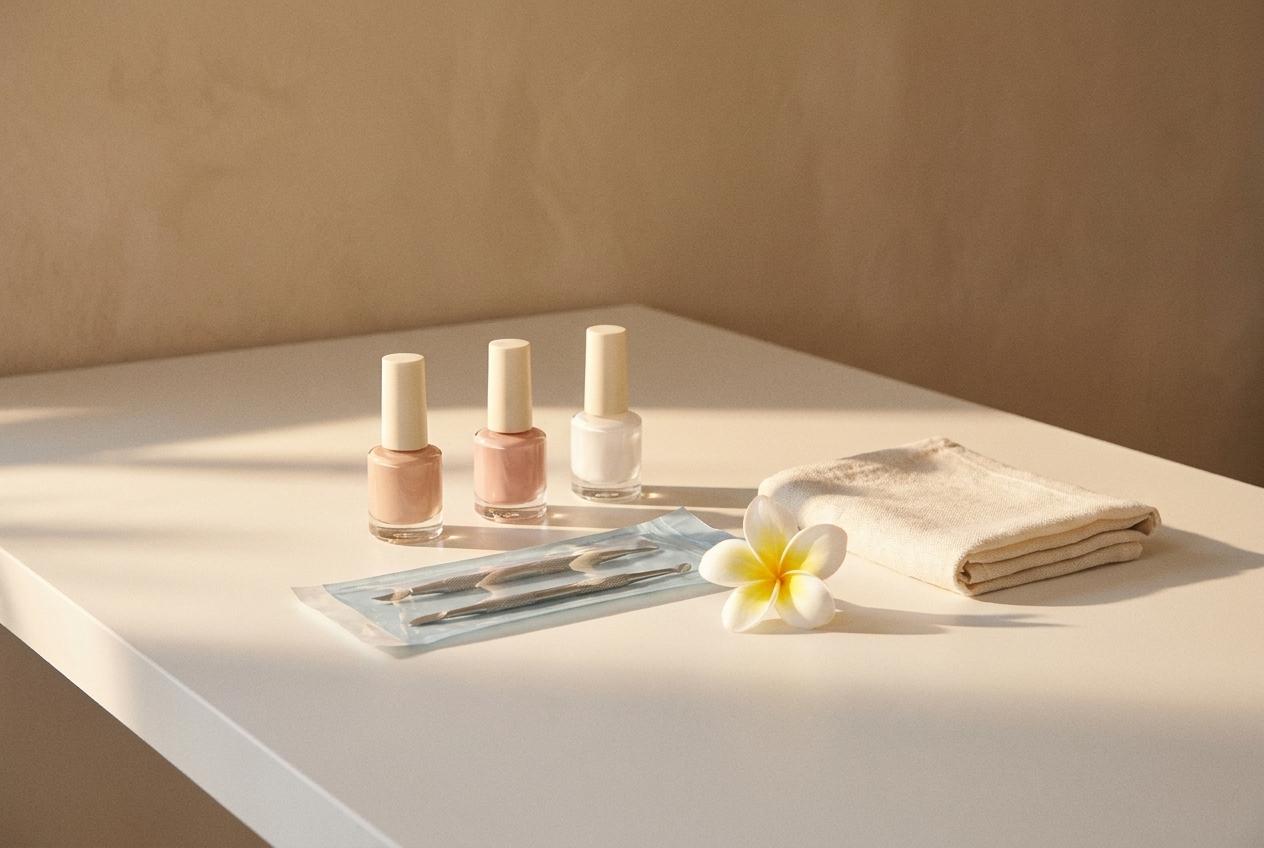
A non-toxic nail salon is one that keeps harsh chemicals off your nails and out of the air you breathe: polish and gel made without the best-known problem ingredients, good ventilation over every table, and tools that are sterilised rather than just wiped. There is no official certificate behind the word "non-toxic", so the honest way to choose a salon in San Diego is to know what to look for and ask.
Here is that checklist, in plain words, and how we answer it at our studio in La Jolla.
The short answer
- The polish: free of formaldehyde, toluene and DBP at the very least. Labels like "10-free" go further.
- The gel: HEMA-free and TPO-free, applied without touching your skin.
- The air: dust and fumes pulled away at the table, not just a fan in the corner.
- The tools: metal tools sterilised in an autoclave and opened from a sealed pouch; files and buffers single-use.
- The method: less acetone, less soaking, less filing of your own nail.
What does "non-toxic" mean at a nail salon?
It's a description, not a standard. The FDA does not approve cosmetics, nail polish included, before they go on sale, and no single rule says what a "non-toxic" nail product must leave out. In practice, people use the word for a salon that avoids the ingredients with the clearest safety concerns and takes care with air and hygiene.
California gives a useful benchmark. Its voluntary Healthy Nail Salon Recognition Program, run by a number of cities and counties, asks salons to drop polishes made with the "toxic trio" (dibutyl phthalate, toluene and formaldehyde), to install mechanical ventilation, to have staff wear nitrile gloves, and to train every technician in safe practice. Wherever a salon is, those are fair questions to ask.
Which ingredients should you look out for?
The toxic trio. DBP, toluene and formaldehyde are the three ingredients California's program asks salons to avoid in polish. Most professional brands have dropped them, but it's still worth a look at the label.
"3-free", "5-free", "10-free". These labels count the ingredients a formula leaves out. "3-free" means the toxic trio; higher numbers add others, such as formaldehyde resin and camphor. The number is a manufacturer's own claim, so a brand that lists what it leaves out is more useful than the number alone.
HEMA in gel. HEMA is a common ingredient in gel products and the one most often behind gel nail allergies. The British Association of Dermatologists has raised concern about a rise in these allergies, which usually start when uncured gel touches the skin. A HEMA-free gel, applied by a trained hand that keeps it off the skin, lowers that risk.
TPO in gel. TPO helps gel harden under the lamp. Since September 2025 it has been banned in cosmetics across the European Union, after being classified as a presumed reproductive toxicant. It is still allowed in the US, so it's worth asking whether a salon's gel is TPO-free.
Why the air in the salon matters as much as the polish
Filing gel and shaping nails makes fine dust, and polish and remover give off fumes. You breathe both for the whole appointment, and the technician breathes them all day. That is why good salons pull the air away at the table itself, where the dust is made. If a salon smells strongly of chemicals when you walk in, that tells you something too.
Clean tools are part of a non-toxic salon
A gentle product means little if the tools aren't clean. Look for metal tools that come out of a sealed, sterilised pouch at your appointment, and files, buffers and sanding bands that are single-use. A UV box or a jar of blue liquid is not the same as sterilisation; an autoclave is the medical standard.
A gentler method helps too
How the nails are done changes how many products you need. A dry Russian manicure uses an e-file and no soaking. Hard gel is filed off rather than soaked in acetone, so there is no bowl of remover at the table. And a waterless pedicure skips the shared foot bath entirely. If you want to compare finishes, our guide to hard gel, gel polish and acrylic goes through each.
Questions to ask a San Diego salon before you book
- Which polish and gel brands do you use, and are they HEMA-free and TPO-free?
- How is the air handled at the table?
- How are metal tools sterilised, and are files single-use?
- How do you remove gel: filing, or soaking in acetone?
- Can I see the product label?
A good salon is happy to answer every one of these.
How we do it at Svitnail in La Jolla
- Gel: Luxio by Akzentz, HEMA-free and TPO-free, odourless, 10-free and cruelty-free, made in Canada.
- Air: Pure Air SHEMAX dust extraction, rated at 99.5% dust capture, so you can breathe easily throughout your service.
- Tools: medical-grade autoclave sterilisation, metal tools opened from a sealed pouch, and single-use tools wherever something can't be sterilised.
- Method: dry Russian manicure with an e-file, hard gel that is filed off rather than soaked, and the waterless SMART Pedicure.
- And a small pleasure: a complimentary drink while you choose your shade.
One of our Google reviews puts it simply: "…you can tell they really take their time + use non-toxic products. … Care was impeccable." (Sarah V., Google review)
Questions we hear
Is gel polish safe?
For most people, yes, when it's a well-made formula applied by a trained technician and fully cured. The main risk is an allergy to ingredients such as HEMA, which usually starts when uncured gel touches the skin. A HEMA-free gel and careful application lower that risk.
Is "non-toxic" nail polish completely free of chemicals?
No. Every polish is made of chemicals, and even the gentlest still uses solvents. "Non-toxic" usually means the formula leaves out the ingredients with the clearest concerns. Read what a brand says it leaves out, not just the number on the bottle.
I'm pregnant. Can I have a manicure?
Ask your doctor first, and tell your technician so they can talk you through the products. A well-ventilated salon and HEMA- and TPO-free gel are a good place to start.
What if I've reacted to gel before?
Tell your technician before the service starts, and consider seeing a dermatologist, who can test which ingredient you react to. Once you know, a salon can tell you whether its products contain it.
Book a visit in La Jolla
We're at 7530 La Jolla Blvd, a few minutes from the ocean, with street parking nearby. We're open Tuesday to Saturday, 9 AM to 7 PM, and booking takes a minute.